
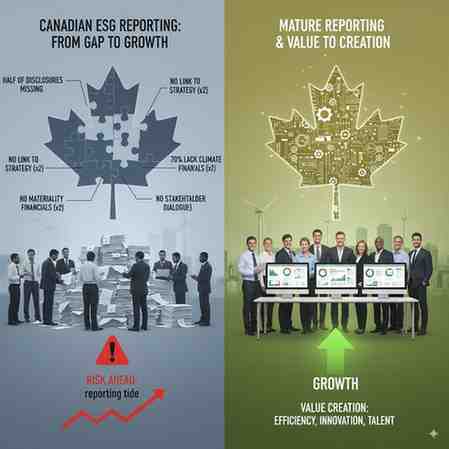
Few Canadian businesses are as yet prepared for the ESG reporting tide. Regulations are becoming more stringent, disclosure needs are increasing, and behind-the-curve businesses can lose investor confidence, competitive standing, and value.
Gaps in ESG Reporting
Most businesses only report roughly half of the ESG/climate disclosure items new rules will soon demand.
More than half fail to make clear how sustainability matters actually influence their business strategy and financial plans.
Approximately 70% lack information regarding the material financial consequences of climate-related opportunities.
Over a third have not conducted a formal materiality analysis.
Most do not explicitly explain how they communicate with stakeholders or define governance frameworks for sustainability management.
What Mature Reporting Looks Like
Definite connection between ESG issues and strategy: companies demonstrating how sustainability is connected to their fundamental business plans perform better.
Defined roles and accountability: when management and boards are named or described in their sustainability roles, disclosures are more likely to be credible.
Metrics, targets, and time horizons: short-, medium-, and long-term objectives; interim milestones; well-defined metrics (including those in value chains).
External assurance: obtaining independent validation of sustainability metrics increases stakeholder confidence.
What Companies Should Do Now
Identify all material ESG risks/opportunities and evaluate how they impact financials.
Regularly update or perform materiality tests to stay in sync with evolving risks.
Develop or enhance information gathering systems, controls, and governance on ESG information.
Incorporate sustainability into strategy and operations (not only reporting).
Begin consolidating ESG reporting (reports, disclosures, sustainability reports) into consistent, accountable yearly reporting.
Make sure that stakeholder comments are meaningfully integrated (not checkbox surveys).
Why This Matters
Regulatory compliance: looming mandatory ESG standards may threaten legal, financial, or reputational risk for those who are not prepared.
Investor demand: well-documented, rigorously measured ESG performance is increasingly shaping capital flows.
Value creation: robust ESG reporting isn’t merely about risk aversion—it opens the door to opportunities in efficiency, innovation, attracting talent, and competitive differentiation.


